Fluorescence quenching:
i. Interaction of a fluorophore with another molecule(s) may provide it protection against a collisional quencher. For example, interaction of a Trp containing peptide with lipid bilayers can be studied using iodide (I− ) as the collisional quencher. The peptide sample in the presence of lipid vesicle is titrated with the potassium iodide (KI) and fluorescence spectra recorded at each quencher concentration. The collisional fluorescence quenching is described by a plot of ‘the ratio of quantum yield in the absence of quencher to that in the presence of quencher' against ‘the quencher concentration'. Such a plot is known as the Stern-Volmer plot. The Stern-Volmer equation is given by

where,
- F0 = Fluorescence intensity in the absence of quencher
F = Fluorescence intensity in the presence of quencher
kq = Bimolecular quenching constant
τ0 = Fluorescence lifetime in the absence of quencher
[Q] = Quencher concentration
Ksv = Stern-Volmer constant
A normalized accessibility factor (NAF) is defined as the ratio of ‘the Ksv in the presence of the binding partner of the fluorophore' to ‘that without the binding partner'.
ii. The fluorescence intensity of a sample increases with an increase in the fluorophore concentration. Beyond certain concentration, however, the fluorescence intensity decreases due to self collisional quenching. This property is often used to study the membranolytic activities of a compound. A fluorescent dye at self-quenching concentrations is trapped inside a lipid vesicle. A membranolytic compound results in the release of the fluorescent dye causing increase in fluorescence emission intensity (Figure 7.3).
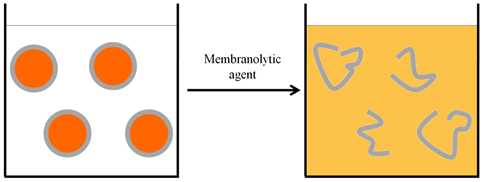
Figure 7.3 Membranolytic activity of a compound monitored through dye release assay. Release of dye from the lipid vesicle diminishes the self-quenching resulting in enhanced fluorescence emission