Binding studies: Binding of small fluorescent molecules to the biomacromolecules can be studied using fluorescence anisotropy. Binding of the fluorophore to a macromolecule will reduce its tumbling (increase its rotational correlation time) thereby resulting in higher fluorescence anisotropy.
FRET:
- i. The distance between two sites in a biomacromolecule such as a protein can be calculated by labeling these sites with suitable donor-acceptor FRET pair. FRET can also be used to study the intermolecular interaction if the interacting molecules comprise of the fluorophores making a FRET pair.
ii. Interactions of peptides and other molecules with lipid bilayers comprising fluorophore labeled lipids. If the interacting molecule makes a FRET pair with the fluorescent lipid, the distance between them can be calculated providing information about the insertion of the molecule in the lipid bilayer.
iii. FRET has been utilized to study the kinetics of enzymatic reactions. For example, a DNA molecule, tagged with the fluorescence donor at one end and an acceptor at the other end can be used as a substrate to study the restriction endonuclease activity and cleavage reaction kinetics (Figure 7.2). A similar assay can be used to study the proteases using peptides as the substrates.
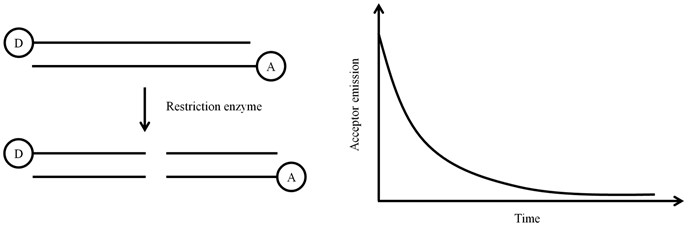
Figure 7.2 Decrease in fluorescence intensity of the acceptor following cleavage of DNA molecules