5-1.4.1. Adenoviruses
- Adenoviruses are medium-sized (90-100 nm), non-enveloped, icosahedral viruses containing linear, double-stranded DNA of approximately 36 kb.
- 57 immunologically distinct types (7 subgenera) of adenoviruses cause human infections.
- They are unusually stable to physical or chemical agents and adverse pH conditions for long-term survival outside the body.
- There are six early-transcription units, most of which are essential for viral replication, and a major late transcript that encodes capsid.
- They result in transient expression in dividingcells as they do not integrate efficiently into the genome, but prolonged expression can be achieved in post-mitotic cells, like neurons.
- Adenoviruses are mostly attractive as gene therapy vectors, because the virions are taken up efficiently by cells in vivo. Adenovirus-derived vaccines have been used in humans with no reported side-effects.
The adenovirus infection cycle comprises two phases-early and late phase,separated by viral DNA replication. The first or "early" phase involves the entry of the virus into the host cell and virus genome to the nucleus. The late genes are transcribed from the major late promoter. The “late” phase involves the formation of gene products related to production and assembly of capsid proteins.
Wild Type Adenovirus Genome
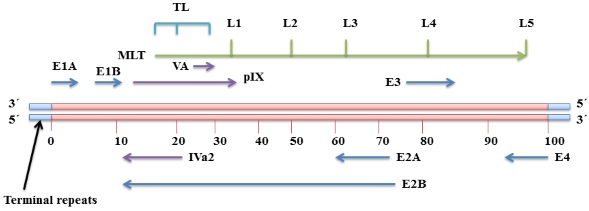
Figure 5-1.4.1(a): A wild type adenovirus genome. (E1A, E1B, E2A, E2B, E3, E4- early genes; L1 to 5- late genes; MLT- major late transcript; TL-tripartite leader; other genes are represented by pIX, IVa2, VA)