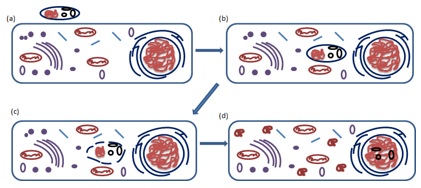
Figure 5-1.2: The process of bactofection (a) the transformed bacterial strain with plasmid containing transgene is transferred to target cell (b) genetically engineered bacteria penetrates into the cell (c) In the cytoplasm, the vector undergoes lysis and get destructed releasing plasmids (d) The released plasmids enter into the nucleus where the transgene is expressed by eukaryotic transcription and translation machinery.
(Adapted from Palffy R, Gardlik R, Hodosy J, Behuliak M, Resko P, Radvansky J, Celec P. 2006. Gene Therapy 13: 101-105)
The efficiency of bactofection mediated gene transfer can be increased using integrin receptors. Integrin receptors are the transmembrane surface receptors present on the mammalian cell surface. Another method, lipofectamine-mediated bactofection has also been employed for enhancing the gene transfer efficiency in E. coli strains, particularly in the transfer of large intact DNA for gene expression. This method is also effective on various widely used bacterial vectors such as L. monocytogenes and S. typhimurium.
Uses
- Bactofection can be used for DNA vaccination against various microbial agents such as viruses, fungi, protozoans and other bacteria.
- It can be used in the treatment of several tumours like melanoma, lung carcinoma and colon carcinoma in mice.
Advantages
- Simple, selective and efficient transfection.
- Low synthesis cost and can be administered easily.
Disadvantages
- Unwanted side effects associated with host-bacteria interaction. This can be reduced by using genetically modified bacteria which contain suicide genes that ease the bacterial destruction and thus reduces the risk of clinical infections.