Q4. Describe the basic steps in Northern Blot reaction.
Ans. The northern blotting involves the following steps:
a) Total RNA is extracted from a homogenized tissue sample or cells. Further eukaryotic mRNA can then be isolated by using of oligo (dT) cellulose chromatography to isolate only those RNAs by making use of a poly A tail.
b) The isolated RNA is then separated by gel electrophoresis.
c) The RNA samples separated on the basis of size are transferred to a nylon membrane employing a capillary or vacuum based system for blotting.
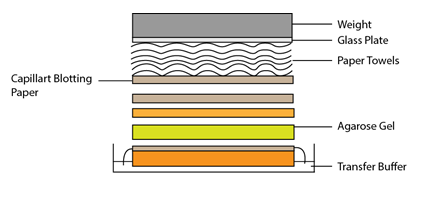
Fig: Setup for Northern blotting
d) Similar to Southern blotting, the membrane filter is revealed to a labeled DNA probe that is complementary to the gene of interest and binds.
e) The labeled filter is then subjected to autoradiography for detection.
Q5. What are the various methods of in-vitro labeling of DNA?
Ans. In vitro labeling of DNA can be done by various methods as follows:
a) Nick-translation
b) Random primed labeling
c) PCR-mediated labeling.
Q6. What are the intercalating agents of DNA and how it helps in mutation process?
Ans. Chemicals such as ethidium bromide and proflavine are mainly intercalating agents which inserts between stacked bases in ds DNA. This insert causes the DNA's backbone to stretch and makes slippage since the bonding between the strands is made less stable by the stretching. Forward slippage results in deletion mutation, while reverse slippage results in an insertion mutation. The intercalation of anthracyclines such as daunorubicin and doxorubicin also interferes with the functioning of the enzyme topoisomerase II, blocking replication as well as causing mitotic homologous recombination.