4. Signal termination by protein phosphatase: Signal termination is final step of signal transduction. The well known route for signal termination is by protein phosphatase enzyme. The signalling process must be terminated after signaling process has been initiated and the information has been transduced to affect other cellular processes, because without such termination cells lose their responsiveness to new signals. Additionally, if termination fails in signaling processes, it may lead to uncontrolled cell growth and thus increases the risk of cancer.
Signal amplification
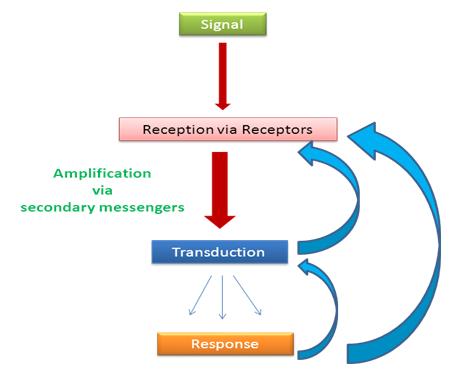
Figure 6: Signal amplification Pathways
Signal amplification is phenomenon in which when receptor proteins interact with the signal molecules at the surface of the cell, in most cases signals are relayed to the cytoplasm or the nucleus by second messengers which influences the activity of one or more enzymes or genes inside the cell. However, most signalling molecules are found in such a low concentration that their effect in cytoplasm would be minimal unless the signal was amplified. Therefore, most enzymes linked and G-protein linked receptor use a chain of other protein messenger to amplify the signal as it is being relayed. Thus in case of protein kinase one cell surface receptor activates many G protein molecules. Each G protein activates many adenylyl cyclases. Each cyclic AMP in turn will activate protein kinase which then activates several molecules of a specific enzyme.
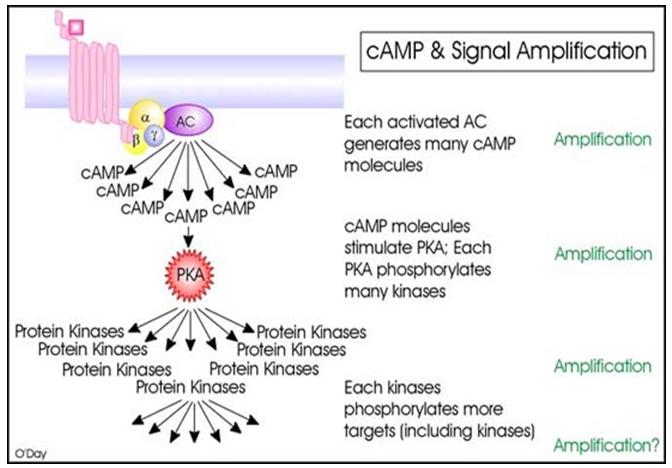
Figure 7: Signal amplification and cAMP