Cell signalling:
As living organisms we are constantly receiving and interpreting signals from our environment. These signals can be light, heat, odours, touch or sound. The cells of our bodies are also constantly receiving signals from other cells. These signals are important to keep cells alive and functioning as well as to stimulate important events such as cell division and differentiation. In animals, rapid responses to the changes in the environment are mediated primarily by the nervous system and by hormones including small peptides, small nonpeptide molecules such as the catecholamines (Dopamine, epinephrine, norepinephrine). We have already studied role of hormones like epinephrine, ACTH and norepinephrine etc in signaling events. We shall discuss downstream process when signaling molecule interacts with receptor. We shall also talk about various secondary messengers involved in signaling process. These signaling molecules are released from the cells and they travel through the blood to their specific target cells as shown in Figure 1. Some molecules are transported long distances by the blood while others have more of local effects. Certain membrane-bound proteins on one cell can directly signal an adjacent cell.
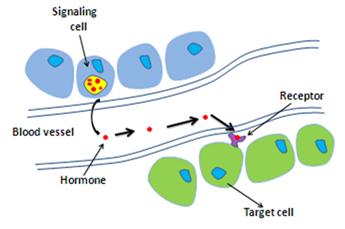
Figure 1: Signaling molecules released from cell and transported by the blood to the target cell
Cell signaling can be divided into 3 stages:
1. Reception : A cell detects a signaling molecule from the outside of the cell. A signal is detected when the ligand binds to a receptor protein on the surface of the cell or inside the cell.
2. Transduction : When the signaling molecule binds to the receptor, it changes the receptor protein. This change initiates the process of transduction. Each relay molecule in the signal transduction pathway changes the next molecule in the pathway.
3. Response : Finally, the signal triggers a specific cellular response as shown in Figure 2.
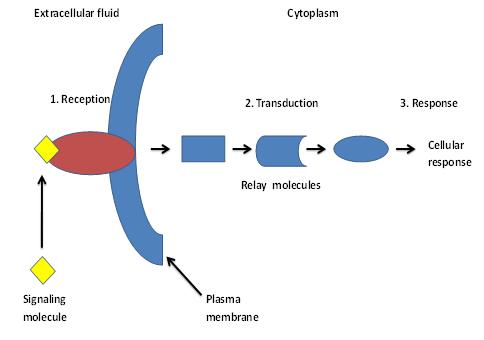
Figure 2: Cell signalling stages