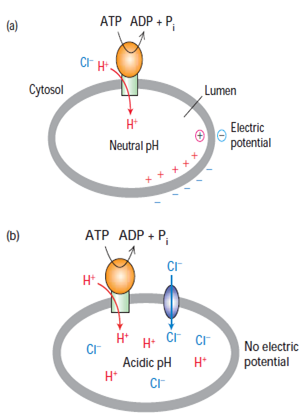
Figure 4: Effect of proton pumping by V-class ion pumps on H+ concentration gradients and electric potential gradients across cellular membranes. (a) If an intracellular organelle contains only V-class pumps, proton pumping generates an electric potential across the membrane, luminal-side positive, but no significant change in the intraluminal pH. (b) If the organelle membrane also contains Cl- channels, anions passively follow the pumped protons, resulting in an accumulation of H+ ions (low luminal pH) but no electric potential across the membrane.
4. ABC (ATP binding cassettes) superfamily:
The final class of ATP-powered pumps is a large family of multiple membranes. This class includes several hundred different transport proteins found in all organisms ranging from bacteria to mammals. Each ABC protein is specific for single substrate or group of related substrate, which may be ions, sugars, amino acids, phospholipids, cholesterol, peptides, polysaccharides or proteins. All ABC transport protein share a structural organization consisting of four core domains: two transmembarne (T) domains, forming the passageway through which transported molecules cross the membrane and two cytosolic ATP-binding (A) domains. The core domains are generally present in separate polypeptides which are more common in bacterial cell. In others, the core domains are fused into one or two multidomain polypeptides. ATP binding leads to dimerization of two ATP-binding domains and ATP hydrolysis leads to their dissociation. Theses structural changes in the cytosolic domains are thought to be transmitted to the transmembrane segments, driving cycles of conformational changes that alternately expose substrate-binding sites on one side of the membrane and then on the other. In this way, ABC transporters use ABC binding and hydrolysis to transport small molecules across the bilayer. Some common example of ABC transporters are found in bacterial plasma membranes which contain amino acid, sugar and peptide transporters. These cells use H+ gradient across the membrane to pump variety of nutrients into the cell. It is also present is mammalian plasma membrane that contains transporters of phospholipids, small lipophillic drugs, cholesterol and other small molecules. One example of eukaryotic ABC transporters is multidrug resistance (MDR) protein which has the ability to pump hydrophobic drugs out of the cytosol. Overexpression of these MDR protein in human cancer cells, make the cells resistant to variety of chemically unrelated cytototoxic drugs.
Interesting facts:
- Valinomycin is a carrier for potassium.
- Lactose permease has been crystallized with thiodigalactoside (TDG), an analog of lactose.
- Adenine nucleotide translocase (ADP/ATP exchanger), which catalyzes 1:1 exchange of ADP for ATP across the inner mitochondrial membrane.
- The reaction mechanism for a P-class ion pump involves transient covalent modification of the enzyme.
- Gramicidin is an example of a channel. It is an unusual peptide, with alternating D and L amino acids. In lipid bilayer membranes, gramicidin dimerizes and folds as a right handed β-helix. The dimer just spans the bilayer.