3. V-class ion pumps:
It is almost similar to F-class ion pumps in structure and function. But none of their subunits are related to each other. F-class pumps operate in reverse direction to F-class. These pumps generally function to maintain low pH of plant vacuoles and lysosome and other acidic vesicles in animal cells by pumping protons from cytosolic to exoplasmic face (inside) of membrane against the proton electrochemical gradient. The acidification between the lysosomal lumen and cytosol lumen can be maintained by production of ATP by cells.
These V-class proton pumps contain two domains: a cytosolic hydrophilic domain (V1) and a transmembrane domain (V0) with multiple subunits in each domain. Binding and hydrolysis of ATP by the B subunits in V1 provide the energy for pumping of H+ ions through the proton-conducting channel formed by the c and a subunits in V0. These V-class proton pumps are not phosphorylated and dephosphorylated during proton transport.
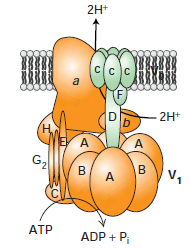
Figure 3: V-class proton pump
These protons cannot acidify by themselves because a net movement of electric charge occurs. Only a few protons build up positive H+ ions on exoplasmic face (inside) and for each H+ pumped across, a negative ion will be left behind on cytosolic face, building negatively charged ions. These oppositely charged ions attract each other on opposite faces of the membrane, generating a charge separation, or electric potential, across the membrane. If more protons pumped, the excess positive ions on exoplasmic face repels other H+ ions and prevents pumping of extra proton long before a significant transmembrane H+ concentration gradient had been established. If the organelle lumen or the extracellular space has to be acidified, the net movements of protons must be accompanied either by movement of equal number of anion eg Cl- in same direction or my movement of different cation in the opposite direction. The first process occurs in lysosomes and plant vacuoles whose membrane contains V-class H+ ATPase and anion channels for Cl- movement. And the second process is observed in the lining of the stomach which contains a H+ /K+ ATPase and pumps one H+ outward and one K+ inward.