Vacuolar membrane:
The V-class H+ ATPase pump is present in vacuolar membrane. More details of V-class H+ ATPase pump is described earlier (Figure 2 and Figure 3).
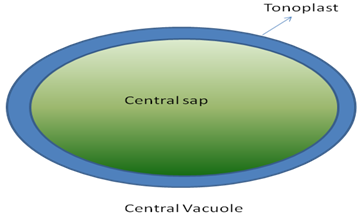
Figure 6: Plant cell vacuole
Other transport proteins present in vacuolar membrane:
1. Proton Pump:
Proton pumps play a central role in the function of the tonoplast by generating a transmembrane H+ electrochemical gradient which can be utilized to drive the transport of solutes. The tonoplast contains different proton pumps, an ATPase and a PPase. V-ATPases (vacuolar-type) are present on different membranes of eukaryotic cells and is constituted of 13 subunits whereas tonoplast PPase is also an integral entity of the tonoplast and consists of one 80 kDa protein.
2. Aquaporins:
Major intrinsic membrane proteins (MIPs), are very small hydrophobic proteins abundantly present in membranes. But these MIPs form water channels. Later α-TIP (tonoplast intrinsic protein) which is a member of MIPs was described and found abundantly. Another major membrane protein of the central vacuole is the γ-TIP (observed in radish). Both TIPs have been shown to act as water channels. α-TIP is associated with the storage vacuole while the γ-TIP is localized on the lytic vacuole. Interestingly, α-TIP has to be phosphorylated in order to exhibit water channel activity.
3. ABC transpoters:
Another class of transporters are ABC type transporters, which are directly energized by MgATP and do not depend on the electrochemical force. Their substrates are organic anions formed by conjugation, e.g. to glutathione.
Examples of solute transport across vacuolar membrane in plant cells:
Transport of products of primary metabolites:
The various types of Primary metabolites could be:
1. Carbohydrates: Sucrose uptake occurs by facilitated diffusion in leaf vacuoles. Later it was also observed that active transport of sucrose takes place for vacuoles isolated from sugar cane cell cultures, which accumulates sucrose at concentrations comparable to those in the stalk tissue and tomato fruit vacuoles. Furthermore, it was also found that sucrose transport was stimulated by MgATP and to occur via a sucrose/H+ antiport in red beet. Larger carbohydrates such as stachyose, which is present in large quantities in Stachys sieboldi, may also be accumulated in the vacuole by proton antiport mechanisms. Many sugar alcohols also found in plants accumulate within the vacuoles. Transport of sorbitol across the tonoplast appears to be ATP-dependent in case of immature apple fruit tissue. Transport experiments suggest that mannitol crosses the tonoplast by facilitated diffusion.
2. Amino acid:
The first amino acid transport system was observed in barley plants. These are carriers or channles which are modulated by free ATP (but not by MgATP) which induces inward as well as outward fluxes of all amino acids tested.