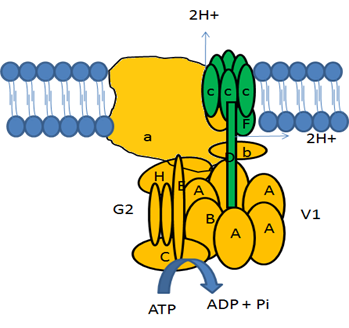
Figure 2: V-class proton pump
These protons cannot acidify by themselves because a net movement of electric charge occurs. Only a few protons build up positive H+ ions on exoplasmic face (inside) and for each H+ pumped across, a negative ion will be left behind on cytosolic face, building negative charged ions. These oppositely charged ions attract each other on opposite faces of the membrane, generating a charge separation, or electric potential, across the membrane. If more protons are pumped, the excess positive ions on exoplasmic face repels other H+ ions and prevents pumping of extra proton long before a significant transmembrane H+ concentration gradient had been established .
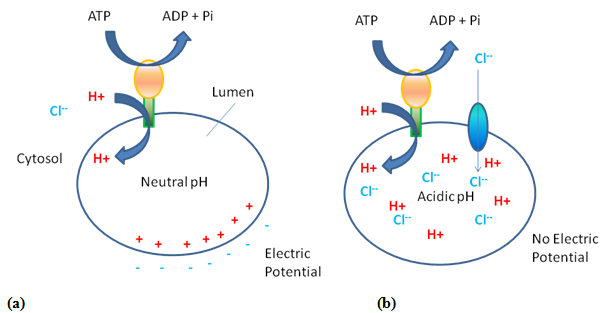
Figure 3: Effect of proton pumping by V-class ion pumps on H+ concentration gradients and electric potential gradients across cellular membranes. (a) If an intracellular organelle contains only V-class pumps, proton pumping generates an electric potential across the membrane, luminal-side positive, but no significant change occurs in the intraluminal pH. (b) If the organelle membrane also contains Cl- channels, anions passively follow the pumped protons, resulting in an accumulation of H+ ions (low luminal pH) but no electric potential across the membrane .
Lysosomal membrane proteins:
Lysosomes are formed by the fusion of transport vesicles budded from Golgi network with endosomes, which contain molecules taken up at the cell surface. And its membrane proteins are usually highly glycosylated proteins decorating the luminal surface of lysosomal membranes. They are most often known as lysosomal associated membrane proteins (LAMP). LAMP-1, LAMP-2 and LIMP-2 are the most abundant components of this membrane. And mainly involved in transport of newly synthesized hydrolases to the lysosome (lysosomal integral membrane protein 2 (LIMP2)) and across the lysosomal membrane (the V-type H+-ATPase complex and chloride channel protein 7 (CLC7).