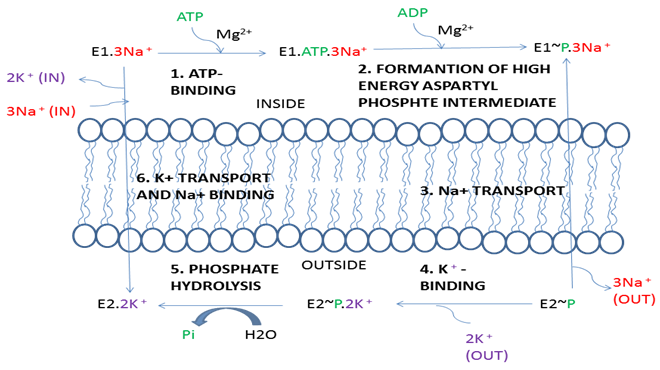
Figure 3: Scheme for the transport of Na+ and K+ by the Na+/ K+ ATPase.
These are mostly target of a large number of toxins and important drug target. Some of the examples are: the naturally occurring steroids called cardiac glycoside such as ouabain and digitalis, inhibit ion transport by Na+/K+ ATPase by binding reversibly to the extracellular side of pump which in turn inhibit ATP hydrolysis and ion transport. Other toxins like palytoxin from marine corals are also specific inhibitor. They block the ATPase in an open state, allowing ions to flow down their concentration gradient, which destroys electrochemical gradient.
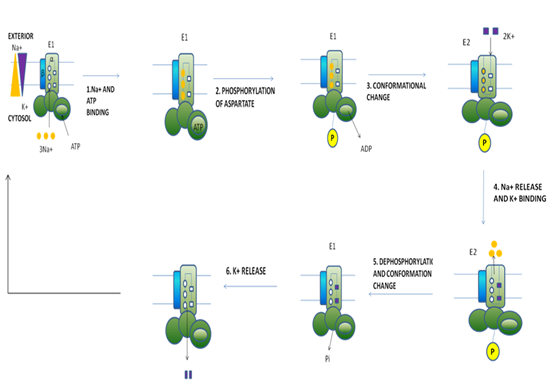
Figure 4: Operational model of the Na+/K+ ATPase in the plasma membrane. Only one of the two catalytic α subunits of this P-class pump is depicted. It is not known whether just one or both subunits in a single ATPase molecule transport ions. Ion pumping by the Na+/K+ ATPase involves phosphorylation, dephosphorylation, and conformational change. In this case, hydrolysis of the E2–P intermediate powers the E2 → E1 conformational change and concomitant transport of two ions (K+) inward. Na+ ions are indicated by red circles; K+ ions, by purple squares; high-energy acyl phosphate bond, by ~P; low-energy phosphoester bond, by –P.