Membrane transport is assisted by various facilitators to ease their job. We will study a few of them in detail.
Permeases
Permeases are a class of membrane transport proteins which facilitate the diffusion of a specific molecule by passive mediated transport . These are divided into following types:
1. Lactose permease: It is a transmembrane protein that consists of N- and C- terminal domains, each consisting of six membrane-spanning alpha helices in a symmetrical fashion. These two domains are well separated and are joined by a single stretch of polypeptide. There are six side chain amino acids that play an important role in the active transport of lactose through the protein. Glutamic Acid 126 , Arginine 144 , and Glutamic Acid 269 plays role in substrate binding activities where as Arginine 302 , Histidine 322 , and Glutamic Acid 325 plays a significant role in proton translocation throughout the transport process. These side chains, make up the active site of the protein and found within the large internal hydrophilic cavity of the lactose permease where the substrate is received for transport and it is the location from which it is sent into the cell.
It is an active co-transport that facilitates the passage of lactose across the phospholipid bi-layer of the cell membrane by using the inwardly directed H+ electrochemical gradient as its driving force. The proton gradient is metabolically generated through oxidative metabolism. The electrochemical potential gradient created by both these systems is used mainly to drive the synthesis of ATP. As a result, the lactose is accompanied from the periplasam to the cytoplasm of the cell by an H+ proton.
Lactose permease has two major conformational states:
1. E-1, which has a low-affinity lactose-binding site facing the interior of the cell.
2. E-2, which has a high-affinity lactose-binding site facing the exterior of the cell.
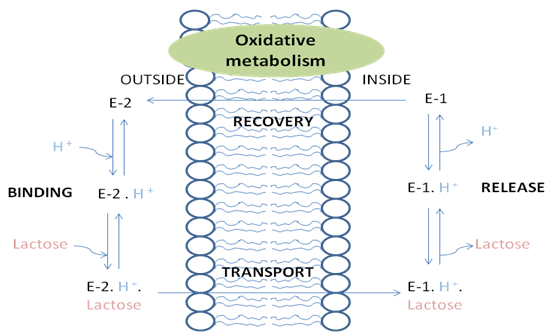
Figure 1: Schematic diagram for the cotransport of H+ and lactose by lactose permease in E.Coli. H+ binds first to E-2 outside the cell, followed by lactose. They are sequentially released from E-1 inside the cell. E-2 must bind to lactose and H+ in order to change the conformation to E-1, thereby cotransporting these substances in the cell. E-1 changes the conformation to E-2 when neither lactose nor H+ is bound, thus completing the transport cycle.
2. β-galactoside permease is a membrane-bound transport protein that facilitates the uptake of β-galactosides across the cell. The common example is melibiose carrier protein from Klebsiella pneumonia, which is capable of using hydrogen and lithium cations as coupling cations for cotransport, depending on the particular sugar transported (H+-melibiose, Li+-lactose).
3. Amino acid permeases are integral membrane proteins involved in the transport of amino acids into the cell. One of the examples of amino acid permease is histidine permease which is a bacterial ABC protein in E.coli and located in the periplasmic space of cell. Histidine binding protein binds histidine tightly and directs it to T sub-units of permease, through which hisitidine crosses the plasma membrane along with ATP hydrolysis.