Examples:
(A)(Na+–K+)–ATPase
(Na+ - K+)–ATPase active transport system is commonly found in the plasma membranes of higher eukaryotes, which was first characterized by Jens Skou. This transmembrane protein consists of two types of subunits: a 110-kD non-glycosylated α- subunit that contains the enzyme’s catalytic activity and ion-binding sites, and a 55-kD glycoprotein β-subunit of unknown function. Sequence analysis suggests that the α- subunit has eight transmembrane α-helical segments and two large cytoplasmic domains. The β- subunit has a single transmembrane helix and a large extracellular domain. The protein may function as an (αβ)2 tetramer in vivo.
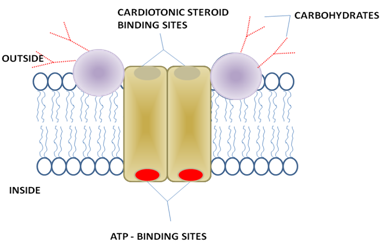
Figure 9: (Na+ - K+) – ATPase. This diagram shows the transporter's dimeric structure and its orientation in the plasma membrane. Cardiotonic steroids bind to the external surface of the transporter, thereby inhibiting transport.
The (Na+ – K+)–ATPase is also called as the (Na+ – K+) pump because it pumps 3 Na+ out of and 2 K+ into the cell in presence of hydrolysis of intracellular ATP. The overall stoichiometry of the reaction is:
3 Na+(in) + 2 K+(out) + ATP + H2O →3 Na+(out) + 2 K+(in) + ADP + Pi
(B)Ion Gradient–Driven Active Transport
For example, cells of the intestinal epithelium take up dietary glucose by Na+ -dependent symport. This process is an example of secondary active transport because Na+ gradient in these cells is maintained by the (Na+ – K+)–ATPase.The Na+ – glucose transport system concentrates glucose inside the cell. Glucose is then transported into the capillaries through a passive-mediated glucose uniport (which resembles GLUT1).
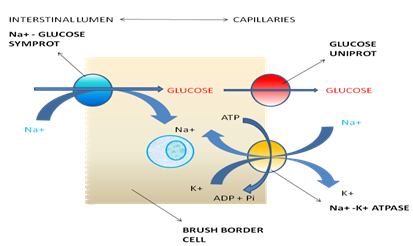
Figure 10: Glucose transport across Interstinal epithelium. The brushlike villi lining the small interstine greatly increases the surface area (a), thereby facilating the absorption of the nutrients. The brush border cells from which the villi are formed (b) concentrate glucose from the interstinal lumen in symport to Na+ (c), a process that is driven by (Na+ – K+) – ATPase, which is located on the capillary side of the cell and functions to maintain a low internal [Na+]. The glucose is exported to the bloodstream via a passive-mediated uniprot system similar to GLUT1.