Types of transport process:
Two types of transport process occur across the membrane.
- Non-mediated transport
- Mediated transport
Non-mediated transport occurs through the simple diffusion process and the driving force for the transport of a substance through a medium depends on its chemical potential gradient. Whereas mediated transport requires specific carrier proteins. Thus, the substance diffuses in the direction that eliminates its concentration gradient; at a rate proportional to the magnitude of this gradient and also depends on its solubility in the membrane’s non-polar core. Mediated transport is classified into two categories depending on the thermodynamics of the system:
1. Passive-mediated transport, or facilitated diffusion: In this type of process a specific molecule flows from high concentration to low concentration.
2. Active transport: In this type of process a specific molecule is transported from low concentration to high concentration, that is, against its concentration gradient. Such an endergonic process must be coupled to a sufficiently exergonic process to make it favorable (ΔG < 0).
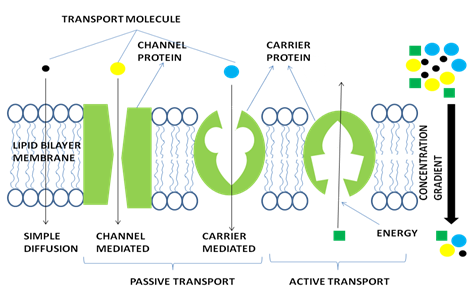
Figure 2: Mediated transport. (A) Passive transport and (B) Active transport
Passive mediated transport:
Substances that are too large or polar diffuse across the lipid bilayer on their own through membrane proteins called carriers, permeases, channels and transporters. Unlike active transport, this process does not involve chemical energy. So the passive mediated transport is totally dependent upon the permeability nature of cell membrane, which in turn, is function of organization and characteristics of membrane lipids and proteins.
Types of passive transport:
1. Diffusion:
The process of the net movement of solutes from a region of high concentration to a region of low concentration is known as diffusion. The differences of concentration between the two regions are termed as concentration gradient and the diffusion continues till the gradient has been vanished. Diffusion occurs down the concentration gradient.
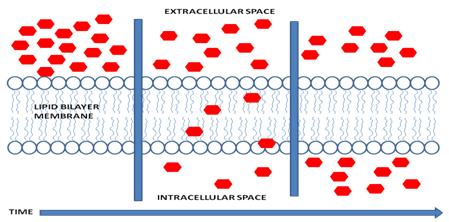
Figure 3: Diffusion. Extracellular space contains high concentration of solutes than intracellular space and hence the solutes move from extracellular space to intracellular space till there is no concentration gradient between the spaces.