2. Facilated diffusion :
The process of the movement of molecules across the cell membrane via special transport proteins that are embedded within the cellular membrane is known as facilitated diffusion or called carrier-mediated diffusion. Many large molecules, such as glucose, are insoluble in lipids and too large to fit into the porins, therefore, it will bind with its specific carrier proteins, and the complex will then be bonded to a receptor site and moved through the cellular membrane.
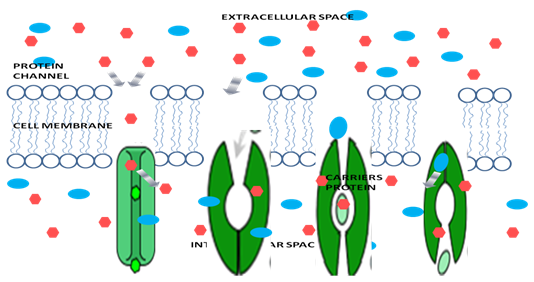
Figure 4: Facilitated transport. Movement of the solutes from extracellular space to intracellular space via carrier proteins and down its concentration gradient.
3. Filtration:
Filtration is the process of the movement of water and solute molecules across the cell membrane due to hydrostatic pressure generated by the system. Depending on the size of the membrane pores, only solutes of a certain size may pass through it. The membrane pores of the Bowman's capsule in the kidneys are very small, and only albumins (smallest of the proteins) can filter through. On the other hand, the membrane pores of liver cells are extremely large, to allow a variety of solutes to pass through and be metabolized.
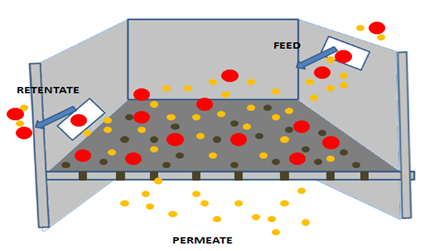
Figure 5: Filtration
4. Osmosis:
Osmosis is the type of diffusion of water molecules across a semi- permeable membrane, from a solution of high water potential to a region of low water potential. A cell with a less negative water potential will draw in water but this depends on other factors as well such as solute potential (pressure in the cell e.g. solute molecules) and pressure potential (external pressure e.g. cell wall).
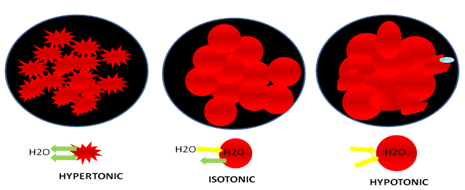
Figure 6: Osmosis. (A) In hypertonic solution, there are more solute molecules outside the cell, which causes the water to be sucked in that direction which leads to the shrinkage of cells. (B) In isotonic solution, there is equal concentration of solute on both sides, henceforth the water with move back in forth. (C) In hypotonic solution, there are less solute molecules outside the cell, since salt sucks and water will move inside the cell. The cell will gain water and grow larger, and finally burst.