Active transport:
Active transport is the movement of a substance against its concentration gradient (i.e. from low to high concentration). It is an endergonic process that, in most cases, is coupled to the hydrolysis of ATP.
Types of active transport:
1. Primary active transport: Primary active transport, also called direct active transport, directly uses energy to transport molecules across a membrane.
Example: Sodium-potassium pump, which helps to maintain the cell potential.
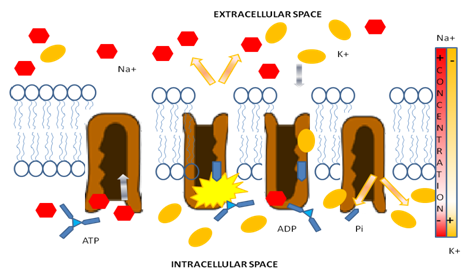
Figure 7: Primary active transport. The action of the sodium-potassium pump is an example of primary active transport.
2. Secondary active transport: Secondary active transport or co-transport, also uses energy to transport molecules acr`-oss a membrane; however, in contrast to primary active transport, there is no direct coupling of ATP; instead, the electrochemical potential difference created by pumping ions out of the cell is instrumental.
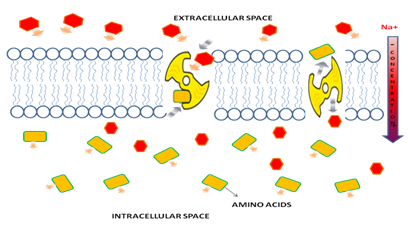
Figure 8: Secondary active transport
The two main forms of active transport are antiport and symport.
1. Antiport:
In antiport two species of ion or solutes are pumped in opposite directions across a membrane. One of these species is allowed to flow from high to low concentration which yields the entropic energy to drive the transport of the other solute from a low concentration region to a high one. Example: the sodium-calcium exchanger or antiporter, which allows three sodium ions into the cell to transport one calcium out.
2. Symport:
Symport uses the downhill movement of one solute species from high to low concentration to move another molecule uphill from low concentration to high concentration (against its electrochemical gradient).
Example: glucose symporter SGLT1, which co-transports one glucose (or galactose) molecule into the cell for every two sodium ions it imports into the cell.