Lysosome: Lysosomes are cellular organelles that contain the hydrolase enzymes which breaks down waste materials and cellular debris. They can be described as the stomach of the cell. They are found in animal cells, while in yeast and plants the same roles are performed by lytic vacuoles.Lysosomes digest excess or worn-out organelles, food particles, and engulf viruses or bacteria. The membrane around a lysosome allows the digestive enzymes to work at the 4.5 pH they require. Lysosomes fuse with vacuoles and dispense their enzymes into the vacuoles, digesting their contents. They are created by the addition of hydrolytic enzymes to early endosomes from the Golgi apparatus.
Centrosome: They are small body located near the nucleus and has a dense center and radiating tubules. The centrosomes are the destination where microtubules are made. During mitosis, the centrosome divides and the two parts move to opposite sides of the dividing cell. Unlike the centrosomes in animal cells, plant cell centrosomes do not have centrioles.
Peroxisome
Peroxisomes are organelles that contain oxidative enzymes, such as D-amino acid oxidase, ureate oxidase, and catalase. They may resemble a lysosome, however, they are not formed in the Golgi complex. Peroxisomes are distinguished by a crystalline structure inside a sac which also contains amorphous gray material. They are self replicating, like the mitochondria. Components accumulate at a given site and they can be assembled into a peroxisome. Peroxisomes function to rid the body of toxic substances like hydrogen peroxide, or other metabolites. They are a major site of oxygen utilization and are numerous in the liver where toxic byproducts accumulate.
Vacuoles and vesicles
Vacuoles are single-membrane organelles that are essentially part of the outside that is located within the cell. The single membrane is known in plant cells as a tonoplast. Many organisms will use vacuoles as storage areas. Vesicles are much smaller than vacuoles and function in transporting materials both within and to the outside of the cell.
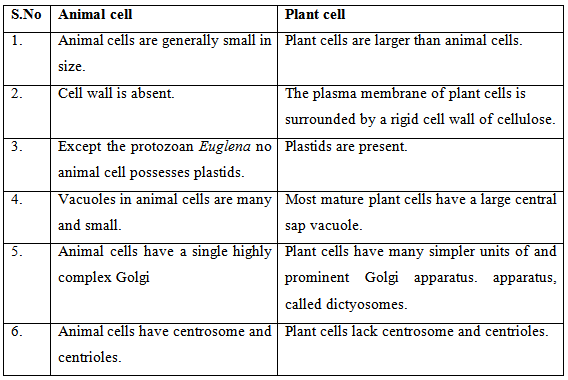
Table 1: Differences between Animal and Plant cell
Some Typical cells:
Cyanobacteria: Cyanobacteria are aquatic and photosynthetic. They are quite small and usually unicellular, though they often grow in colonies large enough to see.
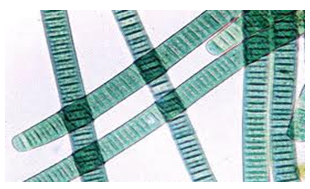
Figure 4: Cyanobacteria