Introduction
It has been discussed earlier that inviscid flows do not satisfy the no-slip condition. They slip at the wall but do not flow through wall. Because of complex nature of Navier-Stokes equation, there are practical difficulties in obtaining the analytical solutions of many viscous flow problems. Here, few classical cases of steady, laminar, viscous and incompressible flow will be considered for which the exact solution of Navier-Stokes equation is possible.
Viscous Incompressible Flow between Parallel Plates (Couette Flow)
Consider a two-dimensional incompressible, viscous, laminar flow between two parallel plates separated by certain distance  as shown in Fig. 5.2.1. The upper plate moves with constant velocity
  while the lower is fixed and there is no pressure gradient. It is assumed that the plates are very wide and long so that the flow is essentially axial
 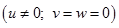 . Further, the flow is considered far downstream from the entrance so that it can be treated as fully-developed.
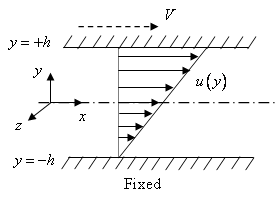
Fig. 5.2.1: Incompressible viscous flow between parallel plates with no pressure gradient.
The continuity equation is written as,
 |
(5.2.1) |
As it is obvious from Eq. (5.2.1), that there is only a single non-zero velocity component that varies across the channel. So, only x- component of Navier-Stokes equation can be considered for this planner flow.
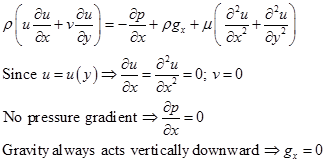 |
|