Case I : Under the favorable pressure gradient conditions 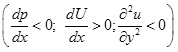 , the velocity profile across the boundary layer is rounded without any inflection point (Fig. 5.11.3-a). No separation occurs in this case and u approaches to
  at the edge of the boundary layer. The wall shear stress
  is the largest compared to all other cases
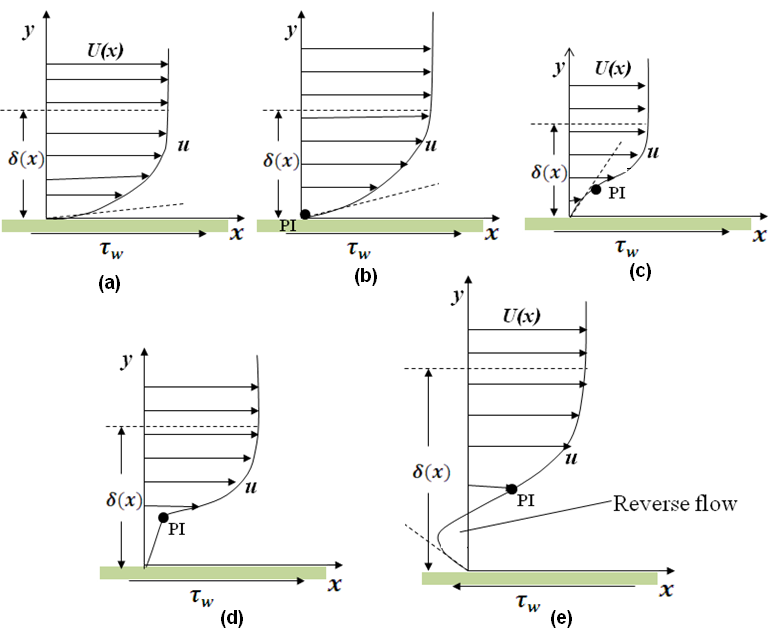
Fig. 5.11.3: Effect of pressure gradient on the boundary layer for a flat plate.
Case II : When pressure gradient is zero, 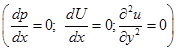 , the point of inflection lies on the wall itself and there is no separation (Fig. 5.11.3-b). It implies a linear growth of u with respect to y for the boundary layer profile and is same as the Blasius boundary layer profile for the flat plate. The flow has a tendency to undergo the transition in the Reynolds number of about 3 ´ 10 6 .
Case III : In a situation of adverse pressure gradient , 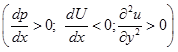 , the outer flow is decelerated . However, the value of
  must be negative when u approaches to at the edge of the boundary layer. So, there has to be a point of inflection
  somewhere in the boundary layer and the profile looks similar to S-shape . In a weak adverse pressure gradient (Fig. 5.11.3-c), the flow does not actually separate but vulnerable to transition to turbulence even at lower Reynolds number of 10 5 . At some moderate adverse pressure gradient, the wall shear stress is exactly zero
 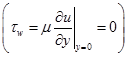 . This is defined as separation point as shown in Fig. 5.11.3(d). Any stronger pressure gradient will cause back flow at the wall that leads to thickening the boundary layer, breaking the main flow and flow reversal at the wall (Fig. 5.11.3-e). Beyond the separation point, the wall shear stress becomes negative
  and the boundary layer equations break down in the region of separated flow.