Turbulent Flat Plate Boundary Layer
A laminar boundary layer over a flat plate eventually becomes turbulent over certain range of Reynolds number. There is no unique value pf Reynolds number, for this change to happen. It mainly depends on the free stream turbulence and surface roughness parameters. With a very fine polished wall and with a quiet free stream, one can delay the transition. A controlling parameter such as the critical Reynolds number of transition  may be defined. On a flat plate with a sharp leading edge in a typical free stream air flow, the transition occurs between the Reynolds number ranges of
 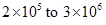 . So the transitional Reynolds number is normally taken as
 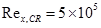 .
.
The complex process of transition from laminar to turbulent flow involves the instability in the flow field. The small disturbances imposed on the boundary layer flow will either grow (i.e. instability) or decay (stability) depending on the location where the disturbance is introduced. If the disturbance occurs at a location where  , then the boundary layer will return to laminar flow at that location. Disturbances imposed on locations
  will grow and the boundary layer flow becomes turbulent from this location. The transition to turbulence involves noticeable change in the shape of boundary layer velocity profile as shown in Fig. 5.11.1. As compared to laminar profiles, the turbulent velocity profiles are flatter and thicker at the same Reynolds number (Fig. 5.11.2). Also, they have larger velocity gradient at the wall.
There is no exact theory for turbulent flat plate flow rather many empirical models are available. To begin with the analysis of turbulent boundary layer, let us recall the momentum-integral relation which is valid for both laminar as well as turbulent flows.
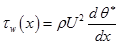 |
(5.11.1) |
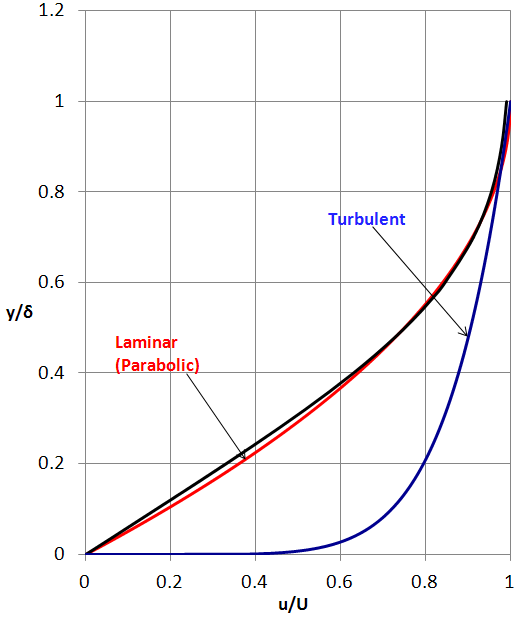
Fig. 5.11.1: Comparison of laminar and turbulent boundary layer profiles for flat plate.
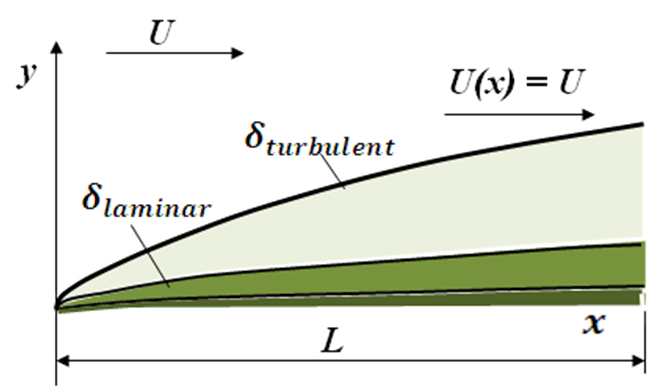
Fig. 5.11.2: Comparison of laminar and turbulent boundary layer profiles for flat plate.