It may be observed that the thickness of a turbulent boundary layer increases as  while it increases as
  for a laminar boundary layer. It means that a turbulent boundary layer grows at a faster rate compared to that of a laminar boundary layer. Eq. (5.11.5) is the solution of a turbulent boundary layer because all the boundary layer parameters can be obtained from this equation as given below;
• Displacement thickness,
 |
(5.11.6) |
• Momentum thickness,
 |
(5.11.7) |
• Turbulent shape factor for flat plate
 |
(5.11.8) |
• Skin friction coefficient,
 |
(5.11.9) |
• Wall shear stress,
 |
(5.11.10) |
• Drag coefficient,
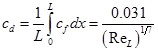 |
(5.11.11) |
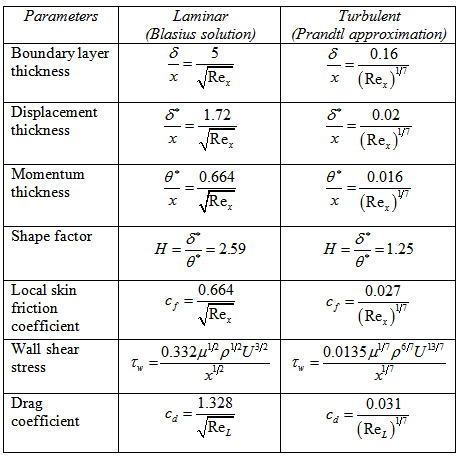
These are some basic results of turbulent flat plate theory. The flat plate analysis for a Blasius laminar boundary layer and turbulent boundary layer is summarized in Table 5.11.1.
Table 5.11.1: Comparative analysis of laminar and turbulent boundary layer flow over a flat plate
 |