UNSOLVED PROBLEMS
PROBLEM 1: While travelling on a dirt road, the bottom of a car hits a sharp rock and a small hole develops at the bottom of its gas tank. If the height of the gasoline in the tank is 30 cm. determine the initial velocity of the gasoline at the hole. Discuss how the velocity will change with time and how the flow will be affected if the lid of the tank is closed tightly. (Answer: 2.43 m/s)
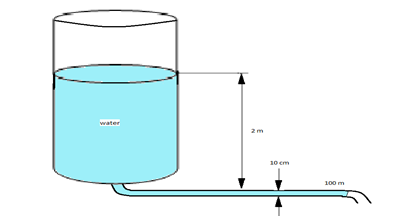
PROBLEM 2: A 2-m high large tank is initially filled with water. The tank water surface is open to the atmosphere, and a sharp-edged 10-cm-diameter orifice at the bottom drains to the atmosphere through a horizontal 100-m-long pipe. If the total irreversible head loss of the system is determined to be 1.5 m, determine the initial velocity of the water from the tank. Disregard the effect of the kinetic energy correction factors. (Answer: 3.13 m/s)
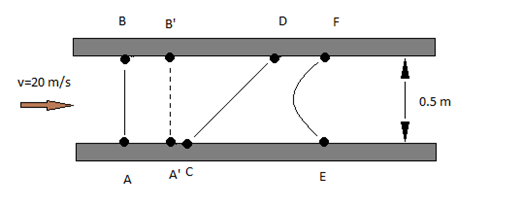
PROBLEM 3: Water flows through a duct of square cross section as shown in fig. with a constant, uniform velocity of V=20 m/s. Consider fluid particles that lie along line A-B at time t=0. Determine the position of these particles, denoted by line A'-B', when t=0.20s. Use the volume of fluid in the region between lines A-B and A'-B' to determine the flow rate in the duct. Repeat the problem for fluid particles originally along line C-D; along line E-F. Compare the answers. (Answer: 5 m3 /s)