Here, Ix is the ‘moment of inertia' with respect to an axis formed by the intersection of the plane containing the surface and free surface (x-axis). Using parallel axis theorem, one may express Ix in terms of second moment of inertia with respect to centroid  and parallel to x-axis i.e.
  . Thus, Eq. (1.2.16) becomes,
 |
(1.2.17) |
In a similar manner, the x-coordinate of the resultant force can be determined by summing the moments about y-axis.
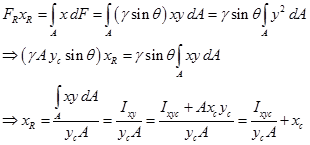 |
(1.2.18) |
where,  is the product of moment of inertia with respect to an orthogonal coordinate system passing through the centroid area and formed by translation of x-y coordinate system. From Eq. (1.2.15), it is clear that the resultant force does not pass through the centroid but always below it. Again, if the submerged area is symmetrical to an axis passing through the centroid and parallel to either x or y axis, the resultant force must lie along the line
  . The point
  through which the resultant force acts is called as “center of pressure”. With the knowledge of engineering mechanics, the centroidal coordinates and moment of inertias for common shapes are given in Fig. 1.2.6.
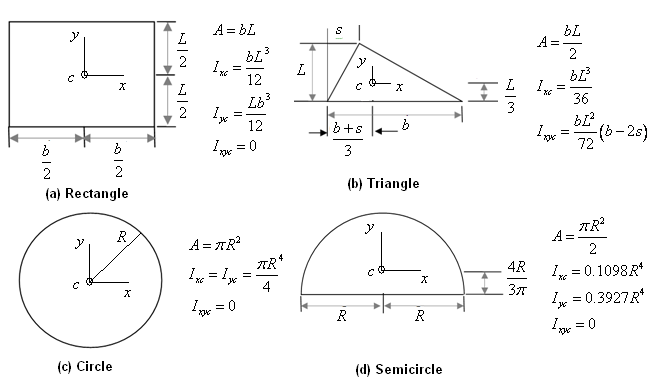
Fig. 1.2.6: Area and moment of inertia of few common shapes.