·
The value of local atmosphere is given by,
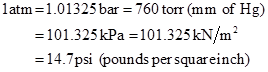
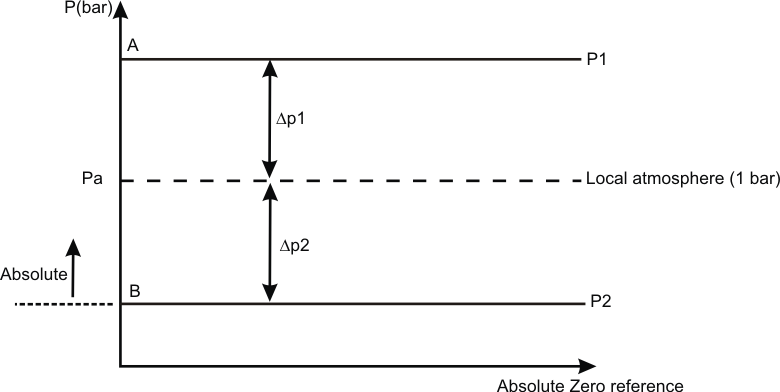
Fig. 1.2.1: Illustration of gauge and vacuum pressure.
- • The pressure gradient is a surface force that acts on the sides of a fluid element. Also, if the fluid element is in motion, it will have surface forces due to viscous stresses. There may be body force due to gravitational potential, acting on the entire mass of the element. By, Newton's second law, the sum of these forces per unit volume
 equals to the density (ρ) times (mass per unit volume) the acceleration
  of the fluid element, i.e.
- • In Eq. (1.2.5), Δp expresses the magnitude and direction of the maximum spatial rate of increase of the scalar property p and is perpendicular everywhere to the surface. The hydrostatic equilibrium will align constant-pressure surfaces everywhere normal to gravity vector. In the customary coordinate system, the direction of z is opposite to the direction of gravity (down), the Eq. (1.2.5) can be written in scalar form as,
 |
(1.2.4) |
This is the general equilibrium equation for a fluid element. Assuming the inviscid assumption  , when the fluid is at rest or at constant velocity
  , the pressure distribution reduces to,
 |
(1.2.5) |
This is hydrostatic pressure distribution and is correct for all fluids at rest, regardless of their viscosity.
 |
(1.2.6) |
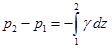
where γ is the specific weight of the fluid. Integrating the above equation,
 |
(1.2.7) |