Manometer pressure instruments
A change in elevation of a liquid is equivalent to the change in pressure (Eq. 1.2.8). Thus a static column of one/more liquids/gases can be used to measure the pressure difference between two points. Such a device is called a manometer . The simplest type of U-tube manometer is shown in Fig. 1.2.3. In the case of open U-tube manometer (Fig. 1.2.3-a), one end is connected to a reservoir ‘A' and other end is open to atmosphere. The hydrostatic formula applicable for this case is,
 |
(1.2.12) |
In case of multi-fluid manometer as shown in Fig. 1.2.3(b), both ends of the tube are connected to the reservoirs ‘A' and ‘B'. The pressure difference can then be computed as,
 |
(1.2.13) |

Fig. 1.2.3: U-tube manometer for determination of hydrostatic pressure.
Hydrostatic force on a plane surface
In the design of storage tanks, ships, dams and many hydraulic static structures, the determination of hydrostatic force is very important. When a surface is submerged in a fluid, forces develop perpendicular to the surface since there is no shearing stress. Also, the pressure will vary linearly with depth if the fluid is incompressible. As shown in Fig. 1.2.4(a), the magnitude of the resultant force at the bottom of a liquid filled tank is given by,
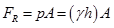 |
(1.2.14) |
Since the atmospheric pressure acts on both sides of the bottom surface, the resultant force is purely due to the weight of the liquid in the tank and acts at the centroid of the area occupied by the liquid. In contrast, when the pressure is not uniformly distributed (Fig. 1.2.4-b), i.e. the pressure varies linearly in the side wall. In such cases, the magnitude and direction of resultant force must be determined from the general expressions given below.
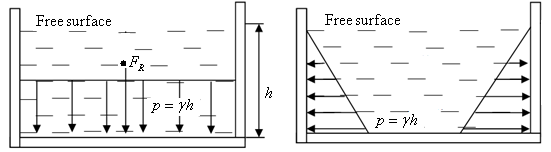
Fig. 1.2.4: Pressure distribution and resultant force in an open tank:
(a) bottom portion of the tank; (b) side of the tank.