In the most general case, we consider an inclined submerged plane surface as shown in Fig. 1.2.5. Let the plane in which the surface lies, intersect the free surface at ‘O' and make an angle θ with the surface. The x-y coordinates are defined such that ‘O' is the origin and all other geometric parameters are given in the Fig. 1.2.5. The area can have any arbitrary shape and it is desired to determine the direction, location and magnitude of the resultant force acting on one side of this area due to the liquid in contact with this area. At any given depth (h), the force acting on the differential area dA is dF=(γh)dA and acts perpendicular to the surface. Integrating this expression, the resultant force may be found from the following analysis;
 |
(1.2.15) |
Here,  is the first moment of inertia with respect to x -axis, yc is the y -coordinate of the centroid area ‘A' measured from x- axis which passes through ‘O' and hc is the vertical distance from the fluid surface to the centroid of the area. Thus, it is clear from the Eq. (1.2.15) that the magnitude of the force is independent of the orientation of the surface and only depends on the specific weight of the fluid, total area and depth of the centroid of the area below the free surface.
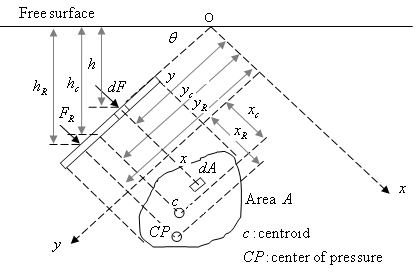
Fig. 1.2.5: Notations for hydrostatic force on any arbitrary inclined plane surface.
It is not always necessary that the resultant force will act at the centroid of the area. In order to calculate the location of this resultant force, let us take the moment of the force and it must be equal to the moment of the distributed pressure force. Considering the summation of moments about x-axis,
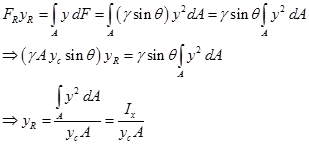 |
(1.2.16) |