- • Thus, the important conclusion about hydrostatic condition is as follows: “Pressure in a continuously distributed uniform static fluid varies only with vertical distance and is independent of the shape of the container. The pressure is the same at all point on a given horizontal plane in the fluid. The pressure increases/decreases with depth of the fluid. The hydrostatic pressure distribution in oceans and atmospheres is shown in Fig. 1.2.2. Considering the sea-level for the reference
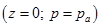 , the pressure decreases with altitude (b) where the fluid medium is air
  . For an ocean, when the depth (h) is increased (vertically downward) the pressure gets increased for water
  .
.
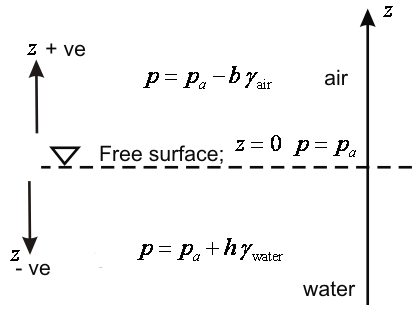
Fig. 1.2.2: Hydrostatic pressure distribution in oceans and atmosphere.
• Liquids are generally incompressible so that the density variations are neglected in hydrostatics. So, Eq. (1.2.7) reduces to the following form;
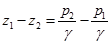 |
(1.2.8) |
where the term  is called as pressure head of the fluid.
- • Gases are compressible with density proportional to pressure. Apply perfect gas law, in Eq. (1.2.6).
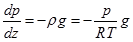
(1.2.9)
where, R is the characteristics gas constant and T is the absolute temperature. Integration of above equation yields,
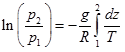 |
(1.2.10) |
This equation needs the assumption of temperature variation T(z) e.g. in an isothermal atmosphere, where T =T0,
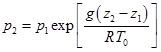 |
(1.2.11) |