Examples: The function  has a removable singularity at
  . The function
  has a pole at
  . The function
  has an essential singularity at
  .
.
Note 1: Suppose that  has a removable singularity at
  . Since
  is an isolated singularity, there exists a punctured neighborhood
  such that
  is analytic in
  . Set
. Set  for
for  and
and 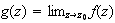 . Then,
  will become analytic in the neighborhood
  and in particular it is analytic at
  . Thus, if
  has a removable singularity at
  , then we can redefine the function
  suitably at the point
  so that
  is analytic at
  . That is why, it is called as a removable singularity and it is actually not considered as a singular point of
  .
.
Note 2: A point  is a pole of
  if and only if
  is a zero of
  . We say that the point
  is a pole of order
  of
of  if and only if it is a zero of order
  of
of  . Therefore, if
  has a pole of order
  at
at  then it can be written as
  where
where  is analytic at
  . A pole of order
  is called the simple pole of
  .
.