Suppose that  is a pole of
  . Consider a neighborhood
  of the point
  . Take any point
  and compute the value of
  . Now, if we plot the points
  in the three dimensional space, then the surface obtained in this manner will have a pole structure about the point
  . That is why, it is called a pole of
  .
.
Note 3: If a point  is an essential singularity of
  then the limit of
  does not exist as
  appproaches
  . The function behaviour as
  approaches
  is quiet complicated.
Suppose that  is an isolated singular point of
  . Then
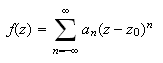
  has a Laurent expansion in
  for some
  . The following theorem characterises the singularities in terms the nature of the Laurent series.
Theorem: Let  have an isolated singularity at the point
  .And let