The following theorem is the strong form of the Casorati Weierstrass theorem, tells the function nature in the vicinity of essential singularity. But its proof demands the concept of normal family and Montel-Caratheodory thereom which is beyond the scope of this introductory course.
(Great) Picard Theorem: Suppose that  has an essential singularity at
  . In any neighborhood
  of
of  , the function
  assumes every complex number as a value, with possibly one exception, an infinite number of times.
Singularities at Infinity: Suppose that  is analytic in
  . Then,
1.
 has a removable singularity at
  if
if  has a removable singularity at
  .
.
2.  has a pole of order
  at
at  if
if  has a pole of order
  at
at  .
.
3.
 has an essential singularity at
  if
if  has an essential singularity at
  .
.
Examples: The function  has a removable singularity at
  . A polynomial
  with
with  and
and  has a pole of order
  at
at  . Every entire transcendental function
 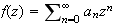 for all
  (for example,
  ,
,  ,
,  ) have an essential singularity at
  .
.