|
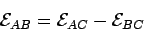
If the temperatures of the two junctions are kept fixed at  and and  , then the emf of a circuit consisting of a pair of metals A and B is equal to the difference between the emfs of two circuits, one consisting of the pair A-C and the other of the pair B-C, i.e. , then the emf of a circuit consisting of a pair of metals A and B is equal to the difference between the emfs of two circuits, one consisting of the pair A-C and the other of the pair B-C, i.e. |
| |
In view of this, it is convenient to measure the thermo-emf with respect to a reference metal C. Platinum is taken to be such a reference. |
| |
In 1834 Jean Peltier, a french watch maker, discovered a second thermoelectric effect. If a current flows through a circuit containing junction of two dis-similar metals, it leads to an absorption or liberation of heat at the junctions. Heat is given out or absorbed depending on the pairs of metals and the direction of the current. The phenomenon of heat evolution is different from the Joule heat as Peltier effect is a reversible process while Joule loss is irreversible. |
| |
If the direction of the current at the junction is same as the direction of the Seebeck current, heat is liberated if the Seebeck junction is a hot junction or is absorbed if the junction is cold. Thus for a copper - constantan thermocouple, if the current flow at the junction is from copper (+) to constantan (-), heat is absorbed. On changing the direction of the current, heat will be liberated at the same junction, showing that the phenomenon is reversible. |