|
where the coefficient of proportionality is known as the thermoelectric power or the Seebeck coefficient. The term thermoelectric power is a misnomer because it does not measure any power and is measured in volt/  K. By convention, Seebeck coefficient's sign is the sign of the potential of the cold end with respect to the hot end. Thus if K. By convention, Seebeck coefficient's sign is the sign of the potential of the cold end with respect to the hot end. Thus if
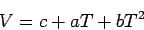
 is positive, convertional current flows from A to B at the hot junction. Seeback coefficient is not a constant but is dependant on temperature. The temperature dependence of a commercial thermocouple is usually expressed as a polynomial expansion in powers of temperature is positive, convertional current flows from A to B at the hot junction. Seeback coefficient is not a constant but is dependant on temperature. The temperature dependence of a commercial thermocouple is usually expressed as a polynomial expansion in powers of temperature  . For instance, for a thermocouple with Platinum as one of the metals and an alloy of Pt-Rh (90:10) the open circuit voltage is given approximately by a quadratic . For instance, for a thermocouple with Platinum as one of the metals and an alloy of Pt-Rh (90:10) the open circuit voltage is given approximately by a quadratic |
| |
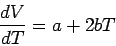
so that the thermoelectric power is given by |
| |
The relationship between  and is a parabola. The temperature and is a parabola. The temperature 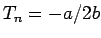 at which the thermoelectric power is maximum is called the neutral temperature . The temperatures at which the thermoelectric power is maximum is called the neutral temperature . The temperatures  and and 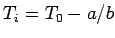 at which a small change in the difference of the junction temperatures leads to a change in the sign of emf is called the inversion temperature. at which a small change in the difference of the junction temperatures leads to a change in the sign of emf is called the inversion temperature. |