|
William Thomson (later well known as Lord Kelvin) discovered a third thermoelectric effect which provides a link between Seebeck effect and Peltier effect.
Thomson found that when a current is passed through an wire of single homogeneous material along which a temperature gradient exists, heat must be exchanged with the surrounding in order that the original temperature gradient may be maintained along the wire. (The exchange of heat is required at all places of the circuit where a temperature gradient exists.) |
| |
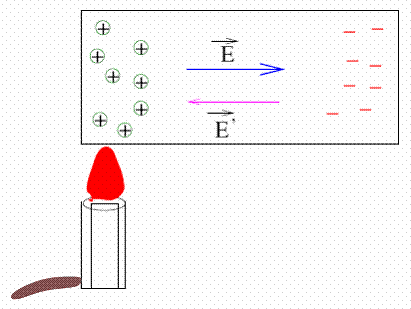
Thomson effect may be understood by a simple picture. A conductor has free charge carriers, which are, electrons in metals, electrons and holes in semiconductors and ions in case of ionic conductors. Consider a section of such a conductor whose one end is hotter than the other end. Charge carriers at the hot end, being more energetic, will diffuse towards the colder end. The charge separation sets up an electric field  . Diffusion of carriers would stop when the attractive force on the carriers due to this field is strong enough to retard the motion of the carriers due to thermal effect. . Diffusion of carriers would stop when the attractive force on the carriers due to this field is strong enough to retard the motion of the carriers due to thermal effect. |