| |
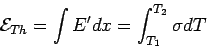
We can represent the effect of the thermal gradient responsible for the diffusive motion of the carriers by an effective field  . This effective field is proportional to the thermal gradient and can be written as . This effective field is proportional to the thermal gradient and can be written as |
| |
where  is known as the Thomson coefficient for the material of the conductor. The Thomson electromotive force is known as the Thomson coefficient for the material of the conductor. The Thomson electromotive force  is given by is given by |
| |
where  and and  are the temperatures at the two ends of the rod. are the temperatures at the two ends of the rod. |
| |
Thomson effect is a manifestation of the Thomson emf described above. Clearly, one cannot demonstrate the existence of the emf by using it to drive a current in a close circuit. This is because if one uses a single metal with a temperature gradient, the integral
 around a close loop is zero. For dis-similar metals, Peltier effect dominates over Thomson effect. around a close loop is zero. For dis-similar metals, Peltier effect dominates over Thomson effect.
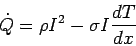
When a current
 is passed through a homogeneous conductor with a temperature gradient, the rate of heat production per unit volume is given by is passed through a homogeneous conductor with a temperature gradient, the rate of heat production per unit volume is given by |