Module 2 : Molecular Structure
Lecture 8 : Hetenuclear Diatomics
  8.4

Hybridization in CO

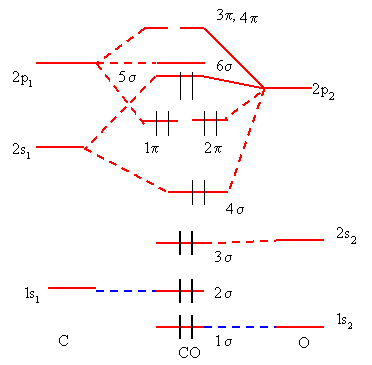
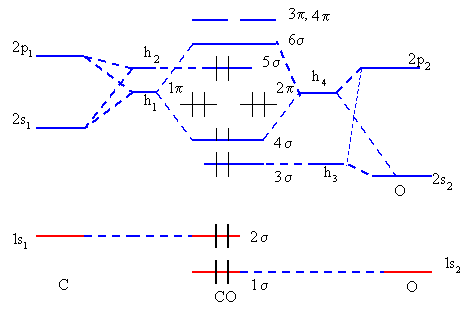
In CO there are a total of 14 electrons, 6 from C and 8 from O. The oxygen orbitals are lower in energy due to its larger nuclear charge. We may construct the MOs in two ways, a) without taking into account the hybridization of the AOs of each atom and b) considering the hybridization of the AOs in each atom. The energy level diagram for both the cases are shown in fig 8.5


Fig 8.5 a) Orbital energy correlation diagram in CO without hybridization.


Fig 8.5 b) Orbital energy correlation diagram in CO with hybridization on C and O
 

The 1s orbital of O and the 1s orbital of C are very close to the nuclei and have very low values of energy and hence do not participate in bonding at all. The 2s orbital of O is also very low lying and does not take part in bonding. In a molecule, all atomic orbitals get converted to molecular orbitals. The inner orbitals may remain 99.999% "pure", but there will be a miniscule participation of other atoms converting them to MOs. This all orbitals in a molecule will be labeled as , and so on. The first two orbitals 1 (from 1s of O) and 2 (1s of C) hardly contribute to bonding and so their energy levels remain unchanged in the molecule.


The 3 orbital, which is essentially the 2s of oxygen, (which is labeled as 2s2) is also "non bonding" and its energy is also "unaffected". The 2s1 (of C) and 2p2 (one of the three 2p orbitals of O, which is directed towards C form bonding and antibonding orbitals 4 and 5. The 4 is a bonding orbital and 5 is an antibonding orbital (it should have been written as 5 *,  * representing antibonding) because its energy is higher than the energy of both the participating atomic orbitals.