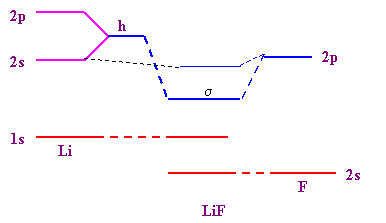
In Fig 8.1, the energy levels of Li and F atoms are given at the left and right of the figure and the energy levels of the MOs are given in the middle.
Fig 8.1 The energy levels of Li, LiF and F. One of the hybrid orbitals formed by the 2s and 2p orbitals of Li is denoted by h.
It is seen that the energy levels of F are lying much lower than those of Li. Such shifts are a common feature in atoms. As the atomic number (nuclear charge) is increased, the inner shells (1s, 2s, 2p .. and so on) are drawn closer to the nuclear charge.The values of energies of these orbitals (core electrons) are much lower than the energies of the "outer" or valence electrons.
The 1s and 2s electrons of F and the 1s electrons of Li hardly participate in bonding. The overlap between 2s orbital of Li and 2p orbital of F is not very strong. This is because the s orbital is spherically symmetrical and not directional and hence does not overlap strongly with the 2p orbital of F.
To "circumvent" this difficulty, the 2s and 2p orbitals of Li combine to give two hybrid orbitals h1and h2, of which h1 is well directed towards the p-orbital of F to form a bonding orbital which has a lower energy than the unhybridized 2s (Li) + 2p (F) combination. The shapes of the hybrid orbitals h1and h2 are shown in Fig 8.2
Fig (8.2) Hybrid orbitals in LiF, (a) s+p (h1) and s-p (h2) combinations in LiF (b) Bonding MO in LiF formed from the h1 of Li and p of F.