Module 3 : Fabrication Process and Layout Design Rules
Lecture 10 : General Aspects of CMOS Technology
 
10.6 Oxide Growth
Oxide gro+wn on silicon may result in an uneven surface due to unequal thickness of oxide grown from same thickness of
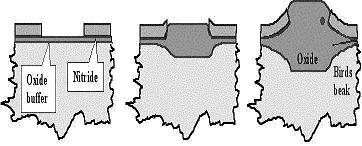
silicon. Stress along the edge of an oxidized area (where silicon has been trenched prior to oxidation to produce a plainer surface) may produce severe damage in the silicon. To relieve this stress, the oxidation temperature must be sufficiently high to allow the stress in the oxide to relieved by viscous flow. In the LOCOS process, the transistor area is masked by SiO2/SiN sandwich and the thick field oxide is then grown. The oxide grows in both the directions vertically and also laterally under the sandwich and results in an encroachment into the gate region called as bird's beak.
Figure 10.6: Formation of bird's beak in MOSFET  
This reduces the active area of the transistor and specially the width. Some improvements in the LOCOS process produce Bird's crest which reduces the encroachments, but it is non-uniform.

The goal is to oxidize Si only locally, whenever a field oxide is needed. This is necessary for the following reasons:

-- Local oxide penetrates into the Si, so the Si-SiO2 interface is lower than the source-drain regions to be made later. This could not be achieved with oxidizing all of the Si and then etching of unwanted oxide.

-- For device performance reasons, this is highly beneficial, if not absolutely necessary.

10.7 Active Mask or Isolation Mask(thin-ox)
It describes the areas where thin oxides are needed to implement the transistor gates and allow implantations to form p/n type diffusions. A thin layer of SiO2 is grown and covered with SiN and this is used as mask. The bird's bead must be taken into account while designing thin-ox.
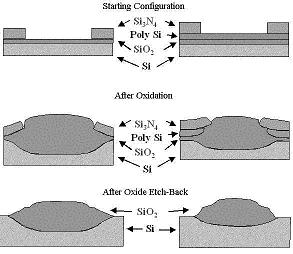
Figure 10.62: Comparison of the LOCOS process with and without some sacrificial polysilicon  


4