| 10.1 Gate Material |
| Metals have several advantages when considered as gate electrodes. The use of metal gates would certainly eliminate the problems of dopant penetration through the dielectric and subsequent gate depletion. The use of metals with appropriate work functions for NMOS and PMOS devices would led to transistors with symetrical and tailored threshold voltages. Most refractory metals are good choices for this application primarily due to their high melting points, which allow them to be used at high temperatures necessary for source-drain implant activation. However thermodynamic stability of metal-dielectric interfaces at processing temperatures are major concerns which need to be addressed in addition to more subtle issues of electrical properties, flat band voltage (ultimately threshold voltages) stability and the charge trapping at the interface. The problem with using aluminium is that once deposited, it cannot be subjected to high temperature processes. Copper causes a lot of trap generation when used as a gate material. |
| |
| 10.2 Parasitic Capacitances |
|
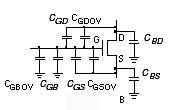
Though a lot of parasitic capacitances exist in a MOSFET as shown in figure 10.2, but those of prime concern to us are the gate to drain capacitance (Cgd) and gate to source capacitance (Cgs) because they are common to input and output nodes and gate multiplied by gain during circuit operation. Thus they increase the input capacitance drastically and decrease the charging rate. |
| Figure 10.2: Parasitic capacitances in MOSFET |
|
| |
|