Causality
Causality refers to cause and effect relationship (the effect follows the cause). In a causal system, the value of the output signal at any instant depends only on "past" and "present" values of the input signal (i.e. only on values of the input signal at "instants" less than or equal to that "instant"). Such a system is often referred to as being non-anticipative, as the system output does not anticipate future values of the input (remember again the reference to time is merely symbolic). As you might have
realized, causality as a property is relevant only for systems whose input and output signals have the
same independent variable. Further, this independent variable must be
ordered (it makes no sense to talk of "past" and "future" when the independent variable is not ordered).
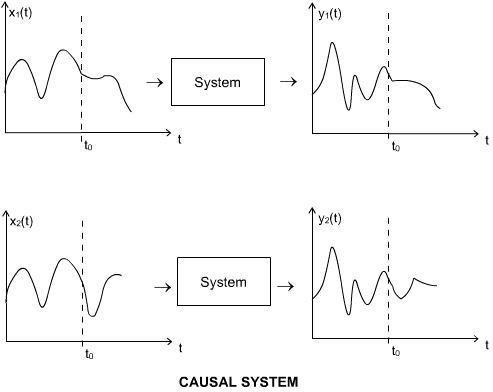
What this means mathematically is that If two inputs to a causal (continuous-time) system are identical up to some time to, the corresponding outputs must also be equal up to this same time (we'll define the property for continuous-time systems; the definition for discrete-time systems will then be obvious).
Definition
Let x1(t) and
x2(t) be two input signals to a system and
y 1(t) and y2(t) be their respective outputs.
The system is said to be causal if and only if:

This of course is only another way of stating what we said before: for
any t0 : y( t0) depends only on values of
x(t) for t <= t0
As an example of the behavior of causal systems, consider the figure below:
The two input signals in the figure above are identical to the point
t = t0, and the system being a causal system, their corresponding outputs are also identical till the point t = t0. 
|


