Stability
Let us learn about one more important system property known as stability. Most of us are familiar with the word stability, which intuitively means resistance to change or displacement. Broadly speaking a stable system is a one in which small inputs lead to predictable responses that do not diverge, i.e. are bounded. To get the qualitative idea let us consider the following physical example.
Example
Consider an ideal mechanical spring (elongation proportional to tension). If we consider tension in the spring as a function of time as the input signal and elongation as a function of time to be the output signal, it would appear intuitively that the system is stable. A small tension leads only to a finite elongation. There are various ideas/notions about stability not all of which are equivalent. We shall now introduce the notion of BIBO Stability, i.e. BOUNDED INPUT-BOUNDED OUTPUT STABILITY.
Statement:
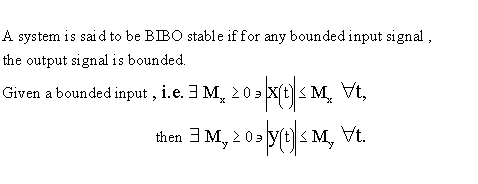
Note: This should be true for all bound inputs
x(t)
It is not necessary for the input and output signal to have the same independent variable for this property to make sense. It is valid for continuous time, discrete time and hybrid systems.
|


