Shift Invariance
This is another important property applicable to systems with the same independent variable for the input and output signal. We shall first define the property for continuous time systems and the definition for discrete time systems will follow naturally.
Definition:
Say, for a system, the input signal x(t) gives rise to an output signal y(t). If the input signal x(t - t0) gives rise to output y(t - t0), for every t0, and every possible input signal, we say the system is shift invariant.
i.e. for every permissible x(t) and every t0 
In other words, for a shift invariant system, shifting the input signal shifts the output signal by the same offset.
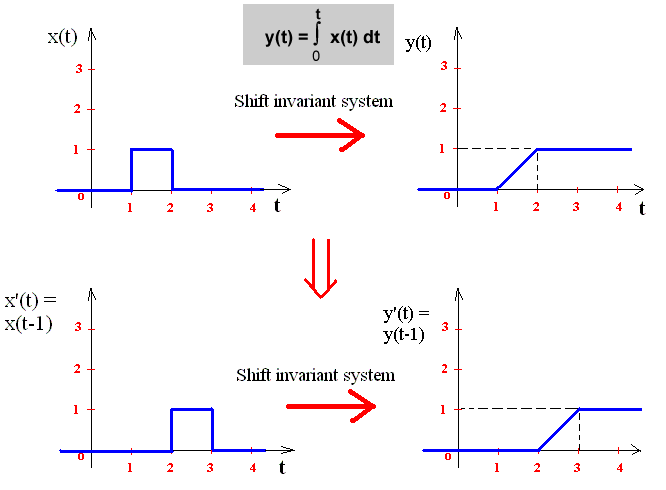
Note this is not to be expected from every system. x(t) and x(t - t0) are different (related by a shift, but different) input signals and a system, which simply maps one set of signals to another, need not at all map x(t) and x(t - t0) to output signal also shift by t0

A system that does not satisfy this property is said to be shift variant.
|


