Module 5 : Signal Distortion on Optical Fibers - Dispersion
Lecture 1 : Signal Distortion on Optical Fibers - Dispersion
Polarization Mode Dispersion (PMD)
As the name suggests, the polarization mode dispersion is due unequal velocities of two orthogonal states of polarization.
The PMD puts the ultimate restriction on the data rate on the long haul single mode optical fiber.
In the weekly guiding approximation i.e. when , The lowest order mode becomes a linearly polarized , mode. That is over the cross-section of the fiber core the field has same direction. See Fig.
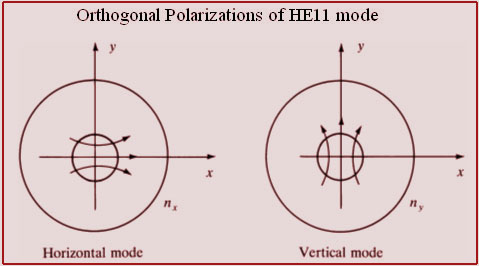
A linearly polarized field can be resolved into two orthogonally polarized fields The pulse energy gets divided into two polarization states as shown in Fig.
Due non-uniformity of the core-radius the effective modal index is different for the two polarizations. The difference in modal indices for two polarization is called the birefringence of the fiber.
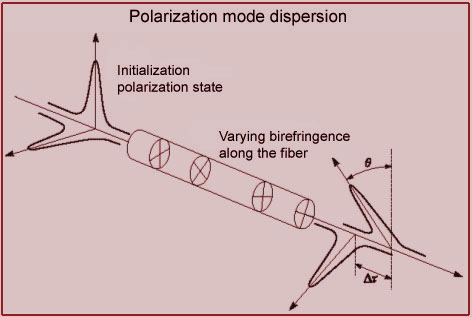
The polarizations consequently travel with different velocities, splitting optical pulse in to two. This phenomenon is called Polarization Mode Dispersion .
No one polarization systematically sees the same modal index. The optical pulse therefore has statistical fluctuation of the polarization.
The pulse slowly broadens due to the statistical fluctuation of the velocities of the two orthogonal polarizations.
The pulse broadening due to PMD is given as
Where is the polarization mode dispersion of the SM fiber, and is the length of the fiber. The unit of PMD is .


 , The lowest order
  mode becomes a linearly polarized ,
  mode. That is over the cross-section of the fiber core the field has same direction. See Fig.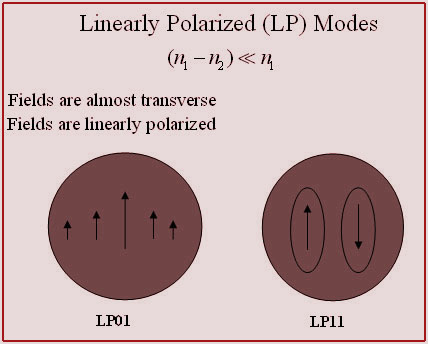

 is the polarization mode dispersion of the SM fiber, and
  is the length of the fiber. The unit of PMD is
  .
. 
