Module 5 : Signal Distortion on Optical Fibers - Dispersion
Lecture 1 : Signal Distortion on Optical Fibers - Dispersion
Dispersion is a phenomenon related to the variation in velocity of different frequencies (wavelengths) or different modes. The velocity of different frequencies can be different due to intrinsic properties of the medium or due to dispersive nature of the bound structure like the optical fiber.
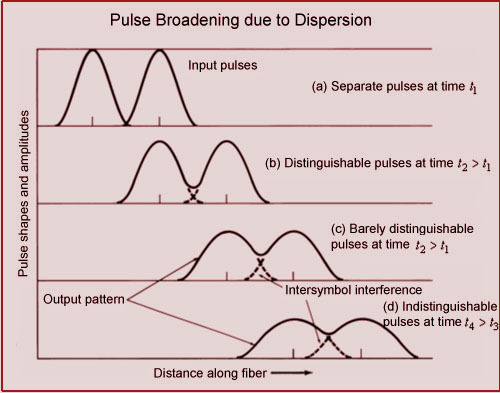
Due to dispersion when the optical pulses travel along the fiber they broaden as shown in Fig. As the pulses travel on the fiber due to broadening, slowly they start overlapping with each other. Consequently, the AC content of the signal reduces and the DC content of the signal increases. After certain distance the pulses barely remain distinguishable. If the signal propagates further the pulses lose their identity and the data is lost.
For given distance, to avoid overlap of the pulses, the pulse separation is to be increased that means the data rate is to be reduced. Alternatively, for a given data rate, that is for given bit separation, the distance has to be less than certain limit. The dispersion therefore has direct impact on the data rate.
NOTE:
It is not the data rate but the Data rate-Distance product which is governed by the dispersion.
We can have general formulation for the dispersion as follows
(1)
First get the group velocity of the pulse.
(2)
Then we find the group delay which is pulse delay per unit distance.
(3)
Find delay over the spectral width and pulse broadening.
(4)
Get dispersion, pulse broadening per unit distance per unit spectral width of the source.
Group Velocity
Group Delay per unit length
Pulse Broadening
Dispersion
= Pulse broadening per unit distance per unit spectral width ( ps/Km/nm)
Where is the propagation constant, is the frequency of the signal and is corresponding free-space wavelength, and is the velocity of light in vacuum.





 is the propagation constant,
  is the frequency of the signal and
  is corresponding free-space wavelength, and
  is the velocity of light in vacuum.
