Module 5 : Signal Distortion on Optical Fibers - Dispersion
Lecture 1 : Signal Distortion on Optical Fibers - Dispersion
Material Dispersion
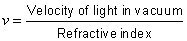
The material dispersion is due intrinsic property of the material. Glass is a dispersive medium. We can recall from our high school physics that glass has different refractive index for different colors. Since the velocity of light is
Different colors (wavelengths) have different velocity in glass.
As mentioned above while calculating the material we assume that there is no waveguide dispersion, that is fiber has infinite radius. The medium then is an unbound medium with refractive index , which is a function of wavelength, .
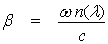
Since the medium is unbound, the propagation constant of light is
Substituting for in above general expression for dispersion, we get material dispersion as
The material dispersion therefore is proportional to second derivative of the refractive index with respect to the wavelength.
Since the second derivative denotes the curvature of the function, the material dispersion is proportional to the curvature of the refractive index function.
Note:
If the refractive index varies linearly with , the curvature is zero and therefore the dispersion is zero.
At this point it is worthwhile to look at the variation of refractive index of glass as a function of frequency.
The refractive of glass is generally described by Sellmeier relation.
Where and are material dependent constants. For silica glass their values are given in Table.
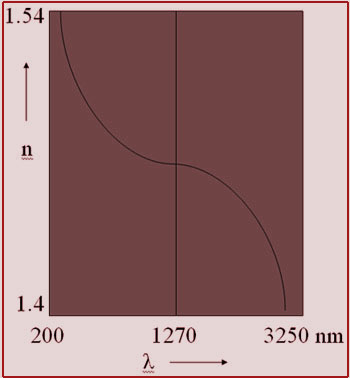
Following Fig. shows the refractive index variation for glass.
Note from the Fig. the following things:
(1)
The refractive index for glass does not vary linearly.
(2)
The curvature of the function is positive below 1270nm and it is negative above 1270nm.


 , which is a function of wavelength,
  .
. 
 in above general expression for dispersion, we get material dispersion as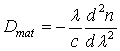
 , the curvature is zero and therefore the dispersion is zero.
 and
and  are material dependent constants. For silica glass their values are given in Table.