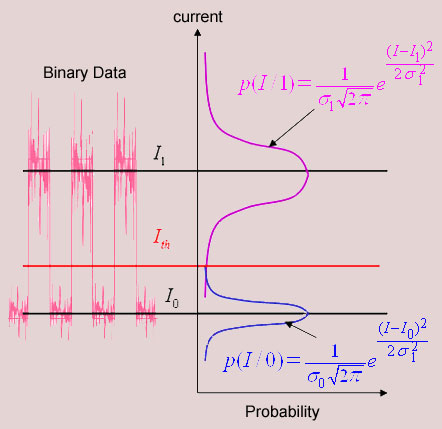
For BER calculation it is assumed that the noise is almost Gaussian with standard deviations  and and  , and means , and means  respectively for the 0 and 1 binary levels. For an optical receiver, in general the two standard deviations are different. For thermal noise dominated regime the two become same. respectively for the 0 and 1 binary levels. For an optical receiver, in general the two standard deviations are different. For thermal noise dominated regime the two become same. |



 .
. 
 . That is
 .
.  .
. 
 is the probability of error in bit-1, i.e. probability of current remaining below the threshold when actually bit-1 has been received.
  is the probability of error in bit-0, i.e. probability of current becoming greater than or equal to the threshold when actually bit-0 has been received.
