Module 10 : Receiver Noise and Bit Error Ratio
Lecture   : Receiver Noise and Bit Error Ratio
                                                                        
                                                                            Shot Noise       
   

The shot noise is because of the random fluctuation in the photo-carrier generation. The shot noise was first investigated by Schottky in 1918.


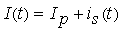
In the presence of the noise the photo current can be written as


where is the instantaneous current of the photo detector, and is current fluctuation due to the shot noise.


The noise current is stationary random process with Poisson statistics.

   
The spectral density of the shot noise is practically constant over a very wide band and hence the noise is almost white .
   

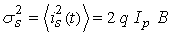
The variance of the shot noise is


where, q is the electronic charge, and is the effective receiver bandwidth. The variance of the noise essentially gives the rms noise power.


The receiver bandwidth depends upon at what location in the receiver the noise is measured. If the noise is measured just after the photo-detector, the bandwidth is equal to the intrinsic bandwidth of the detector. However, if the noise is measured at the end of the receiver, then the transfer function of the receiver comes into picture and the noise variance is given as


The integral essentially gives the effective bandwidth of the system.


All photo-diodes generate a small amount of current even in the absence of optical signal. This is due to the stray light falling on the detector and also due to thermal generation of the carriers. This current is called the dark current , .


The total current in the presence of signal then is the sum of the signal photo-current and the dark current. In a binary digital signal the dark current is generally negligible for bit 1. For bit 0 however, since the optical signal is very low (ideally zero), the dark current is to be taken into account.


Since variance of the shot noise is proportional to the average signal current, the shot noise essentially is a multiplicative noise . The shot noise therefore is a multiplicative white noise.