The thermal noise is because of the random thermal motion of the electrons inside a conductor. The thermal is added in the load resistor connected to the photo-diode.
The thermal noise also has constant spectral density over a very wide frequency range and consequently, thermal noise is also white.
The thermal noise is modeled by Gaussian process. Since this noise is added externally to the photo-current, this noise is additive in nature.
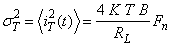
The variance of the thermal noise is given as
where is the Boltzmann constant, is the temperature of the receiver, and is the load resistor connected to the photo-diode. The variance gives the thermal noise power.
The thermal noise does not depend on the signal. Hence it is same for both 1 and 0 bit of the binary signal.
The amplifier following the load resistor also adds the noise. The character of this noise is similar to the thermal noise.
The contribution of the amplifier noise can be accounted for by a parameter called the Noise Figure of the amplifier. The variance of the thermal noise in presence of amplifier is
It may be noted that the thermal noise can be reduced by using high load resistance.
This indeed gives loading problem for the following amplifier. However, that is an independent issue. Generally high input trans-conductance amplifiers are used after the photo-detectors.


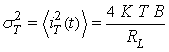
 is the Boltzmann constant,
  is the temperature of the receiver, and
  is the load resistor connected to the photo-diode. The variance gives the thermal noise power.
  of the amplifier. The variance of the thermal noise in presence of amplifier is