Module 10 : Receiver Noise and Bit Error Ratio
Lecture   : Receiver Noise and Bit Error Ratio


                                                         Signal-to-noise Ratio (SNR)
      

The SNR is a ratio of the signal power to the total noise power.


To get total noise power, we assume that the shot noise is approximately Gaussian with of course mean equal to the average photo-current. Then since the shot and thermal processes are independent Gaussian random processes, the variance of the total noise is equal to the sum of the variances of the two noises.


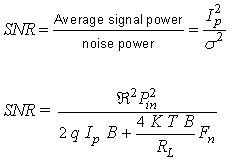
The average mean square value of the photo-current fluctuation is therefore


The signal to noise ratio is


Depending upon the optical signal the thermal noise may dominate over the shot noise and vice versa. Since shot noise is proportional to the signal, the shot noise is dominant at high signal levels, typically higher than -20 dBm.


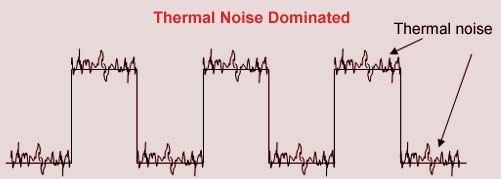
Thermal Noise Dominated Receiver

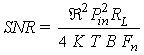
The signal levels at most of the receivers is between -60 dBm to -30 dBm, most of the receivers are thermal noise dominated, i.e. . The SNR in this case is given as


The expressions suggests that the SNR can be improved by

1)

By increasing the signal power ( SNR is proportional to the square of the signal power)

2) By increasing the load resistance


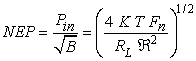
The thermal noise in quantified by a parameter, called the noise equivalent power (NEP) which is defined as


The inverse of NEP is called the detectivity of the receiver.


Typical value of NEP for good receiver lies in the range 1-10 .


From the knowledge of the NEP, one can obtain the signal power needed to achieve a desired SNR.


Since bandwidth is proportional to the data rate in a digital system, the power requirement for a given SNR is proportional to the square of the bandwidth, i.e.