Module 13 : Measurements on Fiber Optic Systems
Lecture     : Measurements on Fiber Optic Systems
  
  Cutt-Off Wavelength
   

As seen during discussion on dispersion, the single mode optical fiber operate very close to the V-number 2.4. The cut-off wavelength is a wavelength at which the next higher order mode gets excited inside the fiber and the fiber does not remain a single mode fiber.


The cut-off wavelength of a fiber should be far enough from the operating wavelength so that even with manufacturing tolerances on the V-number, the fiber remains a single mode optical fiber. Generally the cut-off wavelength is 30-40nm less that the operating wavelength.


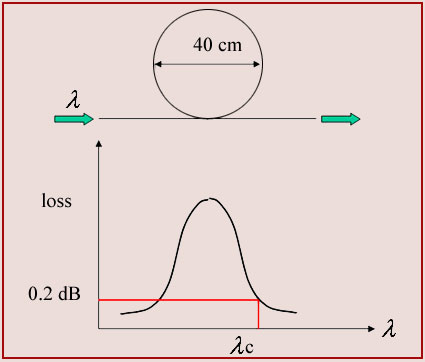
The cut-off wavelength measurement is done in the following way. A fiber forming a 40cm diameter loop is excited with a light source. The output of the fiber is measured as function of wavelength. A typical plot of output power vs wavelength is shown in Fig.


  The output variation can be explained as follows.

When the wavelength is much smaller than the cut-off wavelength, then both, the first mode and the next higher order get excited in the fiber and both are far from cut-off. So both the modes are well guided and there is not much loss in the fiber.


As the wavelength increases, the higher order mode approaches cut-off and its energy spreads in the cladding. Due bending loss, this mode looses the power, so the power which reaches to the output is only the power with the first mode. The output then shows a higher loss.


As the wavelength is increased further, the higher order mode does not get excited at all and the whole power is launched in the first mode which propagates without much loss. The loss on the fiber again reduces with the wavelength. The wavelength at which the loss reduces to 0.2 dB, is called the cut-off wavelength of the fiber.


Cut-off wavelength is not as crucial parameter as the attenuation or dispersion. However its knowledge is useful in deciding the wavelength range of operation.